
Good code is a practice. Governed AI scales it.
 Wyatt SutherlandJuly 12, 20267 min read
I have coached musicians for forty years and software teams for twenty. The lesson is the same: repetition without a standard only entrenches the wrong habit. Good governance brings the standard into the work itself. A governed AI platform made it stick after I was gone.
For more than 40 years I have worked with young cellists who want to build meaningful, sustainable lives as professional musicians. My role is to help them develop enough skill, judgment, and discipline to study at excellent conservatories, work with excellent teachers, and give themselves a real chance in an extraordinarily demanding profession.
No serious cellist expects to reach that level on talent alone. They build habits and practice consistently. They repeat the same passages thousands of times, learning to hear when something is not quite right, understand why, and make increasingly precise corrections.
But repetition alone is not enough. Practicing the wrong movement thousands of times does not create mastery. It makes the wrong movement harder to undo.
The quality of the feedback matters. The standard matters. What is repeated matters. The repetition is not separate from the artistry, it is what eventually makes artistic freedom possible.

For more than two decades I have also worked with software teams, helping them find the problems buried in complicated, long, messy code, and improve it. The work is more similar to teaching the cello than it first appears.
Software teams also want to reach a high bar. They want simpler designs, safer changes, meaningful tests, clearer code, and systems that are easier to maintain. Most developers already know these things matter.
But knowing the standard is not the same as consistently working to it. Under pressure, teams fall back on habits. Sometimes those habits produce good software. Sometimes they produce another layer of complexity, another brittle test, or another change nobody will feel safe touching six months from now.
A before-and-after record
For over a year I have been coaching dozens of software teams at a Fortune 500 company. About eight months ago, across November and December 2025, we introduced the governance platform built by Adeel Ali and ClickChain to one of those teams.
The chart shows what happened next.
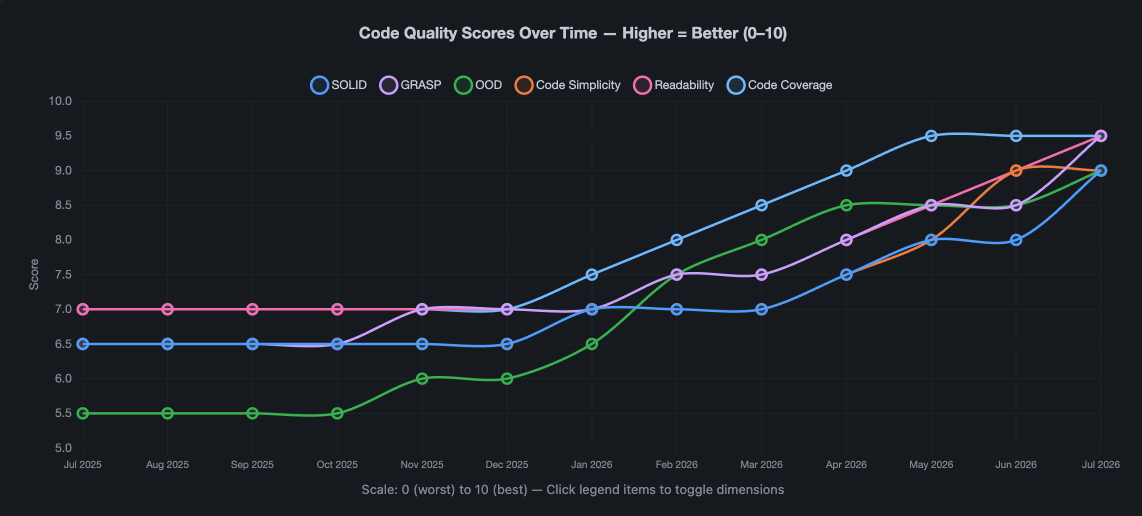
AI governance was introduced into the team's way of working during November and December 2025. Direct coaching ended in early February 2026. The scores come from periodic reviews of the repository against a consistent set of design and testing standards.
For the four months before the platform arrived, the repository's code-quality scores were flat. Once a governed AI platform became part of the team's way of working, the trajectory changed. The first movement was modest. Then the improvement accelerated.
By July 2026, object-oriented design had risen from 5.5 to 9.0. GRASP had climbed from 6.5 to 9.5. SOLID, code simplicity, readability, and coverage had all moved substantially upward as well.
This is one repository and one team. It is not a controlled experiment, and it does not prove every team will see the same results. But it is a clear before-and-after record. The measures were flat before governed development was introduced. They improved consistently afterward, and the improvement was not confined to a single dimension.
What happened after I left
The part I care about most came after I stopped coaching the team directly. By early February, I was gone. The governance platform stayed in the team's way of working. A follow-up review of the repository in July 2026 found that the scores had kept climbing through the spring and into the summer, month after month, well after the coaching had ended.
A good teacher does not want the student to stay dependent on the teacher. The goal is to develop the student's own ability to hear, judge, correct, and keep improving without someone standing beside them for every repetition.
The same is true in software. The team was no longer depending on a coach to remember every standard, spot every design weakness, or press for the next improvement. A repeatable way of working remained after the coach was gone. That is what governance can provide.
Governance is a teacher, not an auditor
The word governance often sounds like restriction. Approvals, committees, documents, another gate to pass before you can do your work. That is not the kind of governance I am describing.
Good governance does not wait at the end of development to inspect the result. It brings engineering principles, testing expectations, design discipline, and organizational standards into the act of development itself. It makes the feedback available while the developer can still use it.
In that sense, governance is less like an auditor and more like a good teacher. A cello teacher does not sit through the final concert and then announce that the technique was wrong. The teacher intervenes early and often, helping the student notice tension in the hand, an unprepared shift, an unclear phrase, a habit that will eventually limit what the player can do. The correction happens close to the work, and it is repeated until it becomes part of the player's technique.
That is what governed, AI-assisted development has begun to do for software teams.
This is not vibe coding
Vibe coding starts with a prompt and celebrates when something appears to work. It can generate a great deal of code very quickly. But speed and volume are not the same as software engineering.
Governed AI-assisted development asks a different set of questions:
- Is the design becoming simpler?
- Is the code safe to change?
- Have we built a meaningful testing safety net?
- Does the behavior belong where it now lives?
- Can another developer understand what was done?
- Are we reducing the future cost of maintaining the system, or just pushing today's complexity forward?
The important difference is not whether AI was used. It is the system of practice around its use.
Without governance, AI reinforces whatever habits already exist. It can produce more coupling, more duplication, more fragile tests, more code that technically works but grows expensive to understand and change. With a strong governance framework, the same speed can be directed toward better design, stronger testing, and clearer intent, with course-correction surfaced while the code is still being written and the team deciding what to do about it.

The graph does not show perfection. Governance does not replace human judgment or remove the need to keep improving. It makes the areas for improvement more visible, makes correction more repeatable, and helps a team keep progressing without waiting for a coach to identify every next step.
A young cellist is not made less expressive by practicing scales, building reliable technique, and receiving demanding feedback. Those disciplines create freedom, the way a richer vocabulary gives a writer more ways to express an idea. They let the musician listen more deeply, respond more quickly, take greater artistic risks, and recover when something unexpected happens.
The same is true for developers. When sound engineering principles and testing practices become part of a reliable way of working, developers are not boxed in. They gain the freedom to change code with less fear, recover from mistakes more quickly, and improve systems that once felt too fragile to touch.
Governed AI can make software development safer and faster. But the more important question is this: what way of working are we making faster?
Because AI will amplify whatever surrounds it. It can amplify disciplined practice, useful feedback, thoughtful design, and continuous improvement. Or it can help us repeat the wrong movements thousands of times. Much faster.
- ai-governance
- software-quality
- coaching